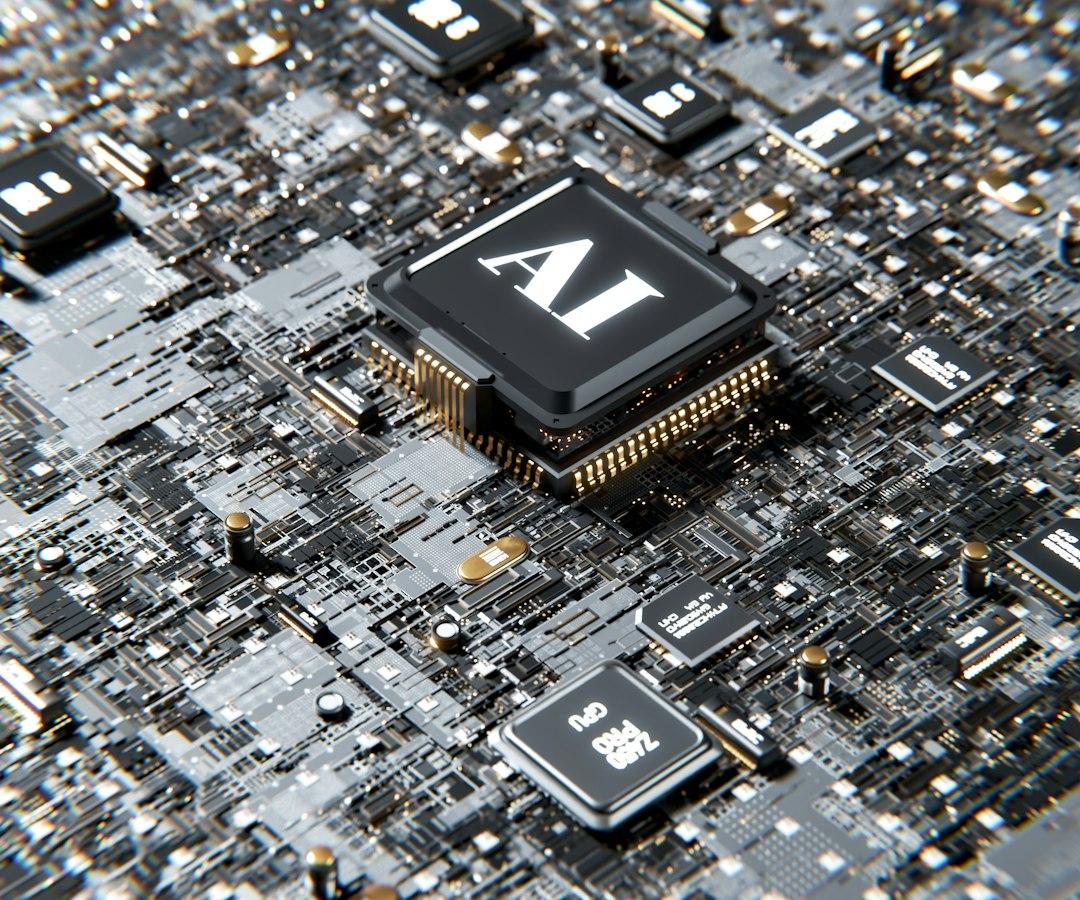
- OpenAI unveiled 'Jalapeño', its first custom-designed silicon for AI inference.
- The chip was developed in partnership with Broadcom to optimize performance and efficiency.
- Custom silicon aims to reduce reliance on general-purpose GPUs and lower inference costs.
- This move marks OpenAI's transition toward vertical integration in its hardware stack.
OpenAI Unveils 'Jalapeño': A Custom Silicon Strategy to Power AI Inference
In a strategic pivot to reduce reliance on third-party hardware, OpenAI has partnered with Broadcom to debut its first proprietary AI inference chip.
Jul 5, 2026·0 views

Key Takeaways
The landscape of artificial intelligence is shifting from model architecture to hardware optimization. OpenAI, the organization behind the ubiquitous ChatGPT, has officially pulled back the curtain on its first custom-designed processor, internally dubbed "Jalapeño." This move marks a significant evolution in the company’s operational strategy, signaling a transition from being a pure software developer to a vertically integrated AI powerhouse.
Developed in collaboration with industry heavyweight Broadcom, the Jalapeño chip is not a general-purpose processor. Instead, it is a highly specialized piece of silicon engineered specifically to handle the unique, high-bandwidth requirements of large-scale AI inference. By moving away from off-the-shelf components, OpenAI aims to achieve a level of efficiency and performance that standard hardware cannot provide.
For years, the AI industry has been constrained by the availability and cost of high-end GPUs, primarily those manufactured by NVIDIA. As OpenAI’s models—ranging from GPT-4 to future iterations—grow in complexity, the computational cost of "inference" (the process of generating responses or "thinking" in real-time) has skyrocketed.
General-purpose GPUs are designed to be flexible, but they often carry overhead that specialized AI workloads do not require. Jalapeño is designed to eliminate that overhead. By optimizing the chip architecture for the specific mathematical operations required by their transformer models, OpenAI expects to:
- Reduce Latency: Faster response times for end-users, even during peak traffic periods.
- Improve Energy Efficiency: Lowering the power-per-token cost, which is vital for sustainability and operational budgets.
- Enhance Scalability: Allowing OpenAI to deploy larger, more complex models across their cloud infrastructure without hitting the same hardware bottlenecks as before.
While OpenAI provided the architectural vision and the specific logic requirements for the Jalapeño chip, the manufacturing and design expertise came from Broadcom. Broadcom has long been a key player in the semiconductor space, known for its ability to help tech giants build custom ASICs (Application-Specific Integrated Circuits).
This partnership follows a growing trend in Silicon Valley. Companies like Google, with its Tensor Processing Units (TPUs), and Amazon, with its Inferentia chips, have proven that custom silicon is the key to long-term dominance in cloud computing. By teaming up with Broadcom, OpenAI is essentially "buying into" a tried-and-tested supply chain, allowing them to focus on the software-hardware interface while leveraging Broadcom’s manufacturing prowess.
Industry analysts suggest that the introduction of Jalapeño is just the beginning. The shift toward custom AI chips is likely to force a reconfiguration of the global supply chain. If OpenAI successfully rolls out Jalapeño across its data centers, it could significantly diminish its dependence on the traditional GPU market, potentially reshaping the balance of power between AI labs and hardware manufacturers.
Furthermore, this development highlights a broader trend in the tech industry: the "commoditization" of general-purpose chips. As AI workloads become the primary driver of global computing demand, the value is shifting toward companies that can create hardware that is "aware" of the software it runs. Jalapeño represents a marriage between advanced neural network architecture and high-performance silicon, a combination that will define the next generation of AI development.
Despite the excitement, the road to hardware independence is fraught with challenges. Designing a chip is only half the battle; integrating it into existing software stacks and ensuring backward compatibility with future model updates is a massive engineering feat. OpenAI will need to maintain a delicate balance between their proprietary hardware and the broader ecosystem of cloud providers.
As we look toward the future, the success of the Jalapeño project will be measured by its ability to lower the cost of intelligence. If OpenAI can make inference cheaper and faster, the barrier to entry for developers and businesses building on top of their models will drop, effectively accelerating the adoption of AI across all sectors of the global economy.
Enjoying this article?
Get the daily AI briefing sent straight to your inbox.
Frequently Asked Questions
What is the OpenAI Jalapeño chip?
Jalapeño is a custom-designed processor created by OpenAI in partnership with Broadcom, specifically built to handle the inference demands of AI models.
Why did OpenAI build its own chip?
OpenAI built Jalapeño to reduce costs, improve energy efficiency, and decrease latency for their large language models, moving away from dependence on general-purpose hardware.
Who manufactured the Jalapeño chip?
The chip was designed by OpenAI and manufactured in collaboration with Broadcom, a leader in ASIC semiconductor production.
Comments
0Please sign in to leave a comment.
Related articles

HiRO-ACEv2: Revolutionizing Weather Forecasting with AI Precision
New AI weather modeling from the Allen Institute for AI promises to democratize climate data by cutting computational costs while maintaining extreme precision.
TII Unveils Falcon ASR: A New Era in Open-Source Speech Recognition
TII has launched Falcon ASR, a state-of-the-art open-source speech recognition model designed to set new benchmarks in accuracy and efficiency.

How the AI Community is Building the Models That Big Tech Won't
When the perfect AI model doesn't exist, the modern developer doesn't wait—they build it. Here is how the open-source movement is reshaping the AI landscape.